News · NEWS
The Clearing House Selects Quant for U.S. Tokenized Deposit Network
Quant will power the interoperability and transaction-management layer of The Clearing House's On-Chain Money Initiative, linking tokenized deposits with RTP and CHIPS.
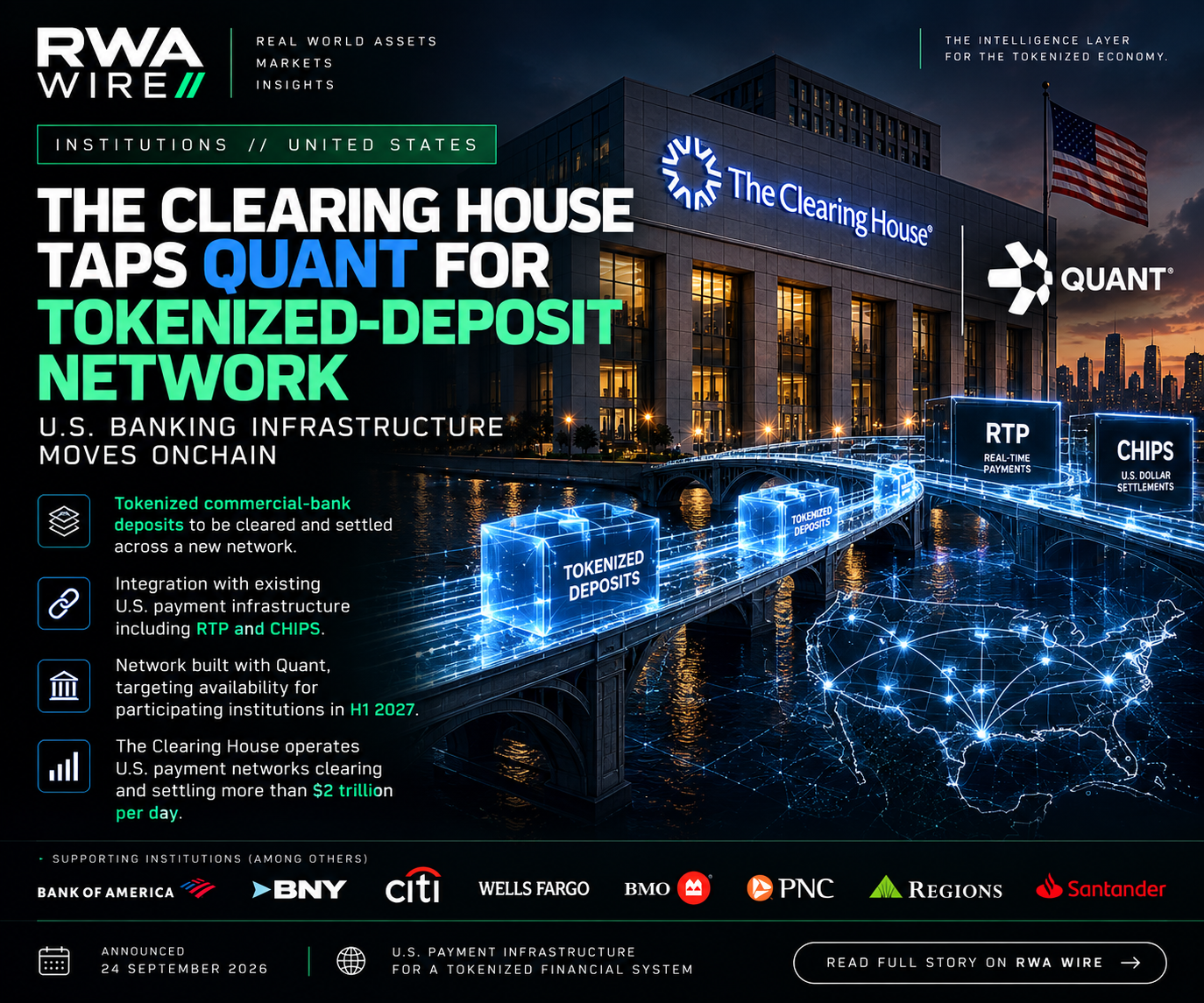
The Clearing House has selected Quant to power key infrastructure for its On-Chain Money Initiative, an interoperable payments network designed to let financial institutions clear and settle tokenized deposit transactions.
Announced on September 24, the partnership places Quant at the interoperability, orchestration and transaction-management layer of the planned network. The system is also intended to connect on-chain activity with established fiat payment infrastructure, including RTP and CHIPS.
That combination matters because the next phase of tokenized finance is not only about issuing assets on distributed ledgers. Institutions also need regulated forms of money and infrastructure capable of moving that money across networks.
What The Clearing House is building
The On-Chain Money Initiative was first announced in June 2026 as a bank-led effort to connect blockchain-enabled activity with traditional payment rails.
Its core objective is to support the clearing and settlement of tokenized commercial-bank deposits between financial institutions while retaining the regulatory and operational framework of the banking system.
The Clearing House says the network is intended to support immediate settlement, programmable transactions and use cases including corporate treasury, liquidity management, cross-border payments and digital-asset settlement.
Unlike a public stablecoin network, tokenized deposits represent deposits issued by regulated financial institutions. They remain bank liabilities while using programmable infrastructure for recording and transferring value.
Quant’s role
According to The Clearing House, Quant will provide technology for three central functions:
- interoperability between participating systems;
- orchestration and transaction management for tokenized-deposit clearing and settlement; and
- connectivity to existing fiat rails, including RTP and CHIPS.
This makes the project an infrastructure story rather than simply another token issuance.
The Clearing House operates U.S. payment networks that it says clear and settle more than $2 trillion each day across wire, ACH, check-image and real-time payments. Extending infrastructure connected to that ecosystem into tokenized deposits represents a significant bridge between existing banking rails and emerging on-chain financial networks.
Why tokenized deposits matter
A tokenized financial system needs both an asset leg and a cash leg.
Tokenized bonds, funds and other securities can gain new settlement capabilities when the money used to pay for them can operate on compatible programmable infrastructure.
Stablecoins already perform this role across much of crypto and public blockchain finance. Banks, however, are also developing tokenized deposits that preserve the commercial-bank deposit model while adding features such as programmability and potentially round-the-clock movement.
The Clearing House initiative is designed around that second model.
From isolated systems toward shared infrastructure
One challenge facing institutional tokenization is fragmentation.
A bank can create its own tokenized deposit system, but its usefulness is limited if it cannot interact efficiently with other banks, ledgers and existing payment networks.
Shared clearing infrastructure could reduce that fragmentation by providing participating institutions with common rails rather than requiring each bank to build bilateral connections independently.
The involvement of RTP and CHIPS is particularly notable because it points toward coexistence between new on-chain systems and established payment infrastructure rather than a wholesale replacement of the latter.
What happens next
The Clearing House says the On-Chain Money Initiative is expected to become available to participating financial institutions in the first half of 2027.
Development is therefore still underway, and important details — including participation, implementation and specific production use cases — remain to be announced.
The significance today is the architecture taking shape: regulated commercial-bank money, programmable infrastructure and existing payment rails are increasingly being designed to work together.
For the tokenized economy, the settlement layer is becoming just as important as the assets themselves.
Sources: The Clearing House, September 24, 2026; Quant, September 24, 2026.
RWA Wire covers real-world assets, tokenization and the infrastructure transforming global finance.
Key takeaways
- The Clearing House selected Quant to power the interoperability, orchestration and transaction-management layer of its On-Chain Money Initiative.
- The network is designed to clear and settle tokenized commercial-bank deposits while connecting with established U.S. payment rails including RTP and CHIPS.
- The Clearing House says the network is expected to become available to participating institutions in the first half of 2027.